

Greg Lewis is a family business advisor and Co-Founder of The Tennessee Center for Family Business in Columbia, Tennessee (www.tncfb.com).
He is the host of the Family Business Today Podcast and serves on the Jennings and Rebecca Jones Chair of Excellence Urban and Regional Planning Advisory Committee at Middle Tennessee State University.
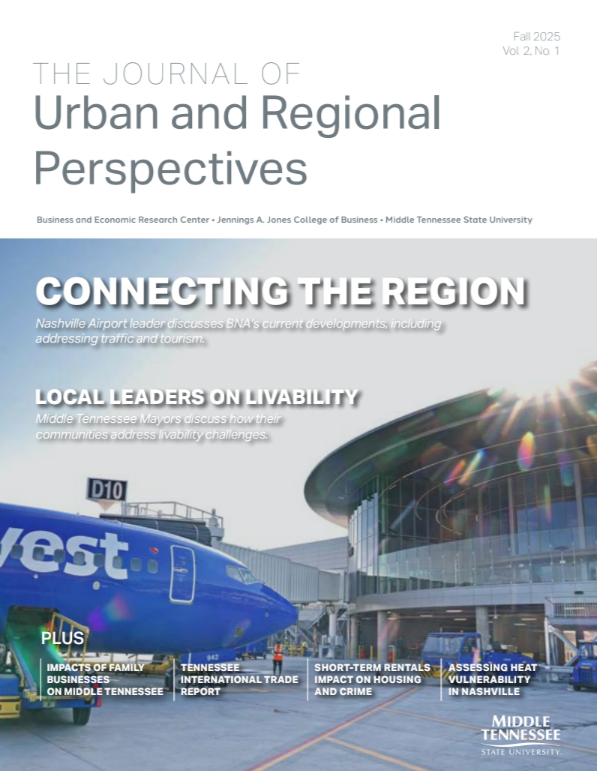
Greg’s Article appeared the Journal of Urban and Regional Perspectives in the Fall of 2025.
Family businesses have historically been the backbone of the American economy, and their impact can be felt in both urban and rural communities across Tennessee. This article explores the economic significance of family businesses in the state, highlighting their contributions to employment, local development, and the challenges they face. By focusing on statistics and providing insights into how these enterprises shape both urban and rural life, we can appreciate the genuine value of family-owned institutions in Tennessee.
The Role of Family Businesses
Family businesses are more than just profit-generating entities; they represent a legacy, a tradition, and an unwavering commitment to the communities they serve. Here are some of the vital statistics that underline their significance:
A Dominant Presence
Family-owned businesses account for 87% of all business tax returns in the United States, translating to approximately 32.4 million enterprises. This vast number illustrates how integral these businesses are to the economy, underscoring their prevalence in daily life. In Tennessee, family-owned businesses range from shops along our town’s main streets to national and international companies that provide jobs to 1000’s of our Tennessee communities. Each one has a positive impact on the economic growth of their community and the state of Tennessee.
For example, Ford Motor Company has been under continuous family control for over 100 years and is one of the largest family-owned companies in the world. On September 27, 2021, Ford Motor Company announced the creation of Blue Oval City. Blue Oval City represents a $5.6 billion investment manufacturing cars and batteries near Stanton, Tennessee, a community with less than 600 residents. BOC is expected to generate 27,000 new jobs and $1.02 billion in annual earnings The project is expected to also generate $178.9 million in state sales taxes and $70.3 million in local sales taxes according to the Tennessee Department of Economic and Community Development.
A Significant Economic Contribution
As of 2021, family firms generated a staggering 64% of the U.S. GDP and provided employment for 62% of the private sector workforce, equating to 83.3 million jobs. In Tennessee, this reflects a robust economic foundation fueled by family-run enterprises.
In 2021, Lodge Manufacturing Company announced an investment of $56 million to expand its South Pittsburg facility, where it has operated for 125 years. The increased production capabilities as a result of the expansion will create 239 jobs in Marion County. “For the past 125 years, Lodge Cast Iron has been a cornerstone for South Pittsburg’s economy. This expansion will continue for generations to come.” South Pittsburg Mayor Samantha Rector
Vital to Small Business Continuity
According to the Small Business Administration, about 40% of business owners are contemplating transitions in the next five years, and the primary reason for failure is inadequate planning. This highlights the delicate nature of family businesses, stressing the need for proper succession planning to ensure continuity and stability for future generations.
The reality is that 100% of us are going to transition whether we want to or not. With a little planning a family business can ensure a successful future that will provide for their family, employees, service providers and the communities that they live in and work.
Impact on Local Communities
Family businesses contribute significantly to the economic and social fabric of both urban and rural settings in Tennessee. Their community-oriented approach often leads to positive ripple effects, which can be outlined as follows:
Employment Creation
Family businesses are critical job creators. They are estimated to be responsible for 78% of all new job creations in the US according to the Cornell SC Johnson College of Business. This is particularly evident in rural areas where job opportunities may be limited. By driving employment, they help maintain economic stability and promote local spending.
Dollywood, jointly owned by the Herschend (Family) Entertainment and Dolly Parton, has a substantial impact on rural Sevier County, Tennessee. They are the county’s largest employer, with a workforce of over 4,000 people. creating an additional 23,000 jobs in the region. “They generate an annual direct economic impact of over $1.8 billion”. (Tennessee Department of Tourism Development Commissioner Mark Ezell)
Unlike larger national companies that relocate to a community, these families lived in the community before they started their business. They have no intention of relocating because this is their home. Many family-owned businesses desire to create a lasting legacy for their family and community. Today many of these family businesses are in their 3rd and even 4th generations of family ownership and/or leadership.
Here are only a few examples of multigenerational family-owned businesses who started in and have remained an important part of Tennessee's economic landscape:
a. Lodge Manufacturing Company, a company with deep roots in South Pittsburg, TN, has been run by the Lodge/Kellerman family since 1896 and remains 100% family owned.
b. Nashville Wire Products Manufacturing Co., based in Nashville, has been manufacturing wire and steel products by the Rollins Family for four generations.
c. The Moon Pie is made by Chattanooga Bakery, in Chattanooga, TN, a privately held, family-owned bakery since 1917.
d. Pictsweet Farms, a family-owned business in Bells, TN, has been growing and distributing frozen vegetables since 1945.
e. Dollywood, a theme park jointly owned by the Herschend (Family) Entertainment and Dolly Parton, has been located in Pigeon Forge, TN since 1961.
Investment in Community Welfare
Family businesses contribute directly to the welfare of their communities by supporting local schools, hospitals, and infrastructure projects. This hidden contribution often goes unnoticed but plays a crucial role in enhancing the quality of life in both urban and rural areas.
In Tennessee, the chances are the company’s name, often the family’s name, and reputation are well known throughout the community for their charitable giving. Their giving not only reflects their values but also their desire to strengthen the ties that bind their family and their business to their community. The family shows their charitable giving not only through their pocketbook but with their time and talents to support those philanthropic causes that are important to their family.
“My great-great grandfather spent the first half of his life making money, and the second half of his life, giving it away – and the family has continued a strong tradition of both business and philanthropy, I see impact investing as a natural continuation of those themes and those family values”
An excellent example in Tennessee is Dolly Parton’s Imagination Library. Over the past 30 years they have distributed millions of children’s books in Tennessee, the US and around the world.
Fostering Entrepreneurship
Family businesses are a hotbed of innovation and entrepreneurship, leveraging their deep industry knowledge and long-term perspective to adapt and grow. This entrepreneurial spirit is often passed down through generations, fostering a culture of innovation within the family. Family businesses stimulate local economies by setting a model for entrepreneurship. Their success encourages individuals within the community to start their ventures, thus promoting a culture of innovation and resilience
In 1968, Hospital Corporation of America (now HCA Healthcare) was founded by Dr. Thomas Frist Sr., Dr. Thomas Frist Jr, and Jack C. Massey. Their entrepreneurial spirit created a new model for hospital care seen today all across the United States. (https://hcahealthcare.com/about/our-history)
Challenges Faced by Family Businesses
Despite their importance, family businesses face unique challenges that can impact their longevity and contribution to the community:
Succession Issues
According to the Family Business Institute, only about 30% of family businesses successfully transition to the second generation. Moreover, only 12% endure the third, and a mere 3% reach the fourth generation. This alarming statistic underlines the urgency for proper succession planning.
Succession planning in family businesses is often derailed by a combination of emotional, structural and relational challenges. When you begin to dig deeper on these issues you find the family is just not talking about them in fear of damaging relationships with their children and/or parents.
Succession planning in a family business is a process and not an event. Start earlier than you think. Business owners are very good at what they do…running their family business. Creating a succession plan is different. They may experience this only once, maybe twice in their career. I hear it often, “Why does succession planning have to be so darn difficult?”
Engaging an external advisor helps families deal with objectivity, emotional intelligence and to balance business needs with personal family dynamics. This process often leads to better long-term outcomes in the succession process.
Economic Pressures
Family businesses often operate with limited resources. Economic downturns, changes in consumer behavior, and increasing competition can disproportionately affect them. Without robust financial backing, many may struggle to survive. According to a 2007 survey by American Family Business the top ten challenges for family businesses are:
1. Succession
2. Labor Costs
3. Healthcare costs
4. Finding qualified employees
5. Foreign competition
6. Labor union demands
7. Domestic competition
8. Oil prices
9. Availability of credit for lenders
10. Estate taxes
Planning for the Future
According to the Small Business Administration 50% of family business owners are considering transitioning in the next 5 years and the primary reason for failure is a lack of planning. In my work as a family business advisor, I often hear family business owners tell me that they think their successors are unqualified or unwilling to take over their company.
The usual suspects in succession planning are a lack of communication. The Now Gen is just not talking to the Next Gen about key issues including their retirement, ownership shares, and what leadership roles each family member will have once they retire. Creating a roadmap for a successful transition can eliminate much of the conflict among siblings and allows discussions among all family members to not feel left out of transition conversations.
Conclusion
Family businesses are vital to both the economy and local communities, providing jobs, fostering innovation, and promoting ethical practices. Their unique structure and values not only facilitate strong internal relationships but also contribute positively to the social fabric of society. As they navigate both opportunities and challenges, family businesses continue to play an integral role in shaping economic landscapes and reinforcing community bonds across Tennessee.
As we look to the future, the onus falls on business owners, communities, and policymakers to bolster family businesses through education and resource accessibility like those available from Middle Tennessee State University. Recognizing and valuing the contributions of family-owned enterprises can pave the way for more resilient local economies and a thriving Tennessee. The legacy of family businesses should not only be preserved but actively encouraged, for in their success lies the prosperity of communities throughout the State of Tennessee.